
What is the BackInAction Knee?

During knee replacement surgery, your doctor has to get past the kneecap (patella) and soft tissue (muscle and tendons) surrounding the knee to access the bones of the joint. In a traditional approach, the surgeon clears a path for performing the knee replacement by making an incision along the inner side of the kneecap – cutting through one of the largest muscle groups in the body, the quadriceps. After the joint replacement is completed, the surgeon sutures any cuts made in the quadriceps muscles and tendons.

The quadriceps run from the hip to the knee at the front of the leg. The normally powerful quadriceps play an important role in many everyday movements, like walking, standing up and climbing stairs. When this muscle is cut during traditional knee replacement surgery, it needs plenty of time to heal and during that time, it may feel weak and painful to move.

That’s where the BackInAction Knee comes in. When performing a total knee replacement with Mako SmartRobotics, your surgeon may choose to use a muscle-sparing approach. With this technique, the surgeon lifts and moves – rather than cuts – the quadriceps to gain access to the joint. By working around rather than through the quadriceps, the surgeon can help minimize the impact on the quadriceps muscles and tendon. This can result in less pain and faster recovery than a traditional approach.1,2

Individual results vary. Talk with your surgeon to see if BackInAction Knee is right for you.
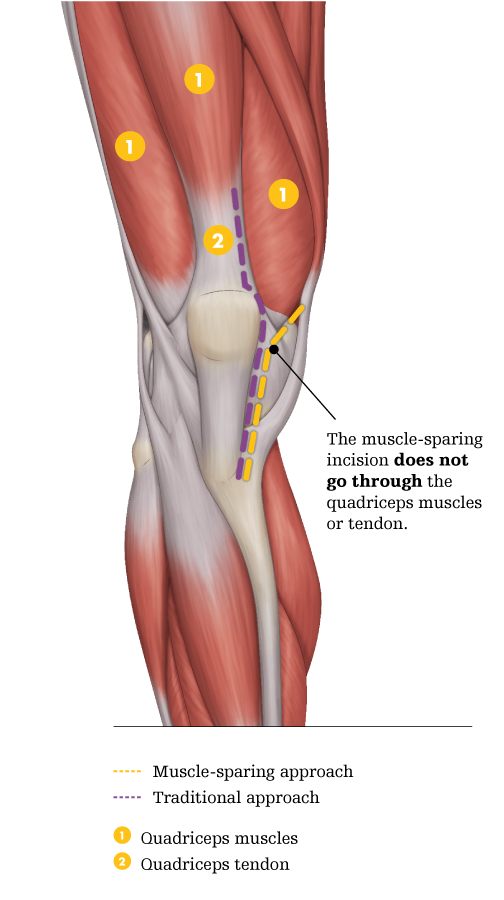
BackInAction Knee subvastus incision vs. traditional incision


Is the BackInAction Knee right for me?

BackInAction Knee may be appropriate for people who:

Experience severe knee pain or stiffness resulting from: noninflammatory degenerative joint disease (including osteoarthritis, traumatic arthritis, or avascular necrosis), rheumatoid arthritis or post-traumatic arthritis.

Haven't experienced adequate relief with conservative treatment options, like bracing, medication or joint fluid supplements.

Consult with a healthcare professional who advises them that this may be an option to help address their specific condition.

Find a BackInAction™ Knee Surgeon

References:
  1. Stubnya BG, Kocsis K, Váncsa S, Kovács K, Agócs G, Stubnya MP, Suskó E, Hegyi P, Bejek Z. Subvastus Approach Supporting Fast-Track Total Knee Arthroplasty Over the Medial Parapatellar Approach: A Systematic Review and Network Meta-Analysis. J Arthroplasty. 2023 Dec;38(12):2750-2758.
  2. Liu HW, Gu WD, Xu NW, Sun JY. Surgical approaches in total knee arthroplasty: a meta-analysis comparing the midvastus and subvastus to the medial peripatellar approach. J Arthroplasty. 2014 Dec;29(12):2298-304.

IMPORTANT INFORMATION

Total knee replacement is intended for use in individuals with joint disease resulting from degenerative, rheumatoid and post-traumatic arthritis, and for moderate deformity of the knee. Knee replacement surgery is not appropriate for patients with certain types of infections, any mental or neuromuscular disorder which would create an unacceptable risk of prosthesis instability, prosthesis fixation failure or complications in postoperative care, compromised bone stock, skeletal immaturity, severe instability of the joint or known or suspected sensitivity and/or allergy to any material in the device.

As with any surgery, knee replacement surgery has serious risks which include, but are not limited to, pain, infection, bone fracture, peripheral neuropathies (nerve damage), circulatory compromise (including deep vein thrombosis (blood clots in the legs)), genitourinary disorders (including kidney failure), gastrointestinal disorders (including paralytic ileus (loss of intestinal digestive movement)), vascular disorders (including thrombus (blood clots), blood loss, or changes in blood pressure or heart rhythm), bronchopulmonary disorders (including emboli, stroke or pneumonia), heart attack, and death.

Implant related risks which may lead to a revision include dislocation, loosening, fracture, nerve damage, heterotopic bone formation (abnormal bone growth in tissue), wear of the implant, metal and/or foreign body sensitivity, soft tissue imbalance, osteolysis (localized progressive bone loss), and reaction to particle debris. Knee implants may not provide the same feel or performance characteristics experienced with a normal healthy joint.

The information presented is for educational purposes only. Speak to your doctor to decide if joint replacement surgery is appropriate for you. Individual results vary and not all patients will return to the same activity level. The lifetime of any joint replacement is limited and varies with each individual. Your doctor will counsel you about how to best maintain your activities in order to potentially prolong the lifetime of the device. Such strategies include not engaging in high- impact activities, such as running, as well as maintaining a healthy weight. It is important to closely follow your doctor’s instructions regarding post-surgery activity, treatment and follow-up care.

Stryker Corporation or its divisions or other corporate affiliated entities own, use or have applied for the following trademarks or service marks: BackInAction, Mako, SmartRobotics, Stryker. All other trademarks are trademarks of their respective owners or holders.


JR-GSNPS-PTNT-3977350

Please upgrade your internet browser.

Our website was designed for a range of browsers. However, if you would like to use many of our latest and greatest features, please upgrade to a modern, fully supported browser.

Find the latest versions of modern supported browsers »

Note: If you are browsing in Internet Explorer 9 or later, and you are still seeing this message, you may be in Compatability Mode. Look for the Compability View icon in your Address bar, or the Compatability View and Compatability View settings from the Tools Menu in your Internet Explorer toolbar (hit the ALT key if your menu bar is hidden). If you are on an Intranet, you may need to contact your IT Support about Compatability View settings and whitelists.